The production and manufacturing difficulties of professional-level gaming headphones
As the e-sports industry moves towards specialization and professionalism, professional gaming headphones are no longer ordinary audio peripherals, but precision products integrating acoustic technology, intelligent control, and ergonomics.
Compared with consumer-grade gaming headphones, professional-grade products have more stringent requirements for sound quality accuracy, latency control, stability, and durability. Their production and manufacturing process involves the integration of technologies in multiple fields, facing many insurmountable difficulties. As an enterprise deeply engaged in the headphone OEM/ODM field for many years, we have deeply insight into industry pain points and accumulated mature experience in addressing various manufacturing difficulties in the process of serving professional e-sports brands.
Accurate control of acoustic performance is the core difficulty in the production and manufacturing of professional gaming headphones.
Professional-grade products need to meet both the competitive demand of "sound localization" and the listening comfort of long-term wearing, with extremely high requirements for the accuracy of frequency response, sound field positioning, and noise reduction effect. On the one hand, key game sounds such as gunfire and footsteps in gaming scenarios are concentrated in the mid-to-high frequency range. It is necessary to accurately tune the sound unit to ensure sufficient high-frequency resolution without harshness, while ensuring moderate low-frequency extension to avoid masking key sounds. This requires strict control over the diaphragm material and coil winding precision of the dynamic coil unit during production; any slight deviation may affect the accuracy of sound field positioning. On the other hand, the integration of active noise cancellation technology is quite difficult. Professional-grade headphones need to balance environmental noise cancellation and voice call clarity, effectively filtering external noise without suppressing teammates' voices. This places extremely high requirements on the debugging of noise cancellation chips and the calibration of microphone pickup accuracy, and each batch of products needs to be individually acoustically calibrated, which greatly increases production complexity and costs.
The stable implementation of low-latency transmission technology is another major pain point in the manufacturing process.
In professional e-sports competitions, audio latency directly affects players' performance. Professional gaming headphones need to control latency within 20ms; wired headphones need to achieve near-zero latency transmission, while wireless headphones need to break through the problems of signal interference, power consumption control, and latency balance. During production, the welding precision of the wireless module and the design of signal shielding are crucial. If the welding is deviated or the shielding is inadequate, problems such as signal freezes and latency fluctuations are likely to occur. At the same time, there is a contradiction between the battery life and latency of wireless headphones. To ensure long battery life while maintaining low-latency transmission, it is necessary to accurately match the battery capacity with the power consumption of the transmission chip, which places higher requirements on component selection and circuit design debugging during production. Only through repeated testing and optimization can performance balance be achieved.
Balancing ergonomic design and durability is an important challenge in the manufacturing of professional gaming headphones.
Professional players wear headphones for training and competitions for hours every day. The weight of the headphones, the fit of the earcups, and the elasticity of the headband need to be accurately adapted to the head contours of different people, ensuring comfortable wearing without pressing the ears, while having sufficient stability to avoid slipping during intense operations. This requires strict selection of earcup materials and headband toughness during production, using high-quality materials such as slow-rebound protein leather and lightweight alloy. At the same time, product structure is optimized through a large number of ergonomic data tests. The consistency control of materials and the precision of structural assembly all require the support of refined production processes. In addition, professional-grade headphones need to have extremely strong durability, able to withstand long-term high-frequency use, frequent plugging and unplugging, and slight collisions. This places much higher requirements on shell materials and interface technology than ordinary headphones. During production, it is necessary to strictly control injection molding precision and interface plugging life to reduce product failure rates.
The control of multi-scenario adaptation and quality consistency further increases the manufacturing difficulty.
Professional gaming headphones need to be compatible with multiple platforms such as PCs, game consoles, and e-sports mobile phones. There are differences in audio protocols and interface standards between different platforms. During production, multi-protocol compatibility needs to be achieved, while ensuring consistent sound quality and latency performance across different platforms. In addition, professional-grade products have extremely high requirements for quality consistency. The acoustic performance, latency parameters, and appearance craftsmanship of each batch of headphones need to be consistent. This requires establishing a strict quality control system during production, with precise control over every link from component procurement, production and assembly to finished product testing. The refinement of the testing process also increases the production cycle and labor costs.
Faced with the above manufacturing difficulties, our company has formed a mature solution based on years of OEM/ODM service experience.
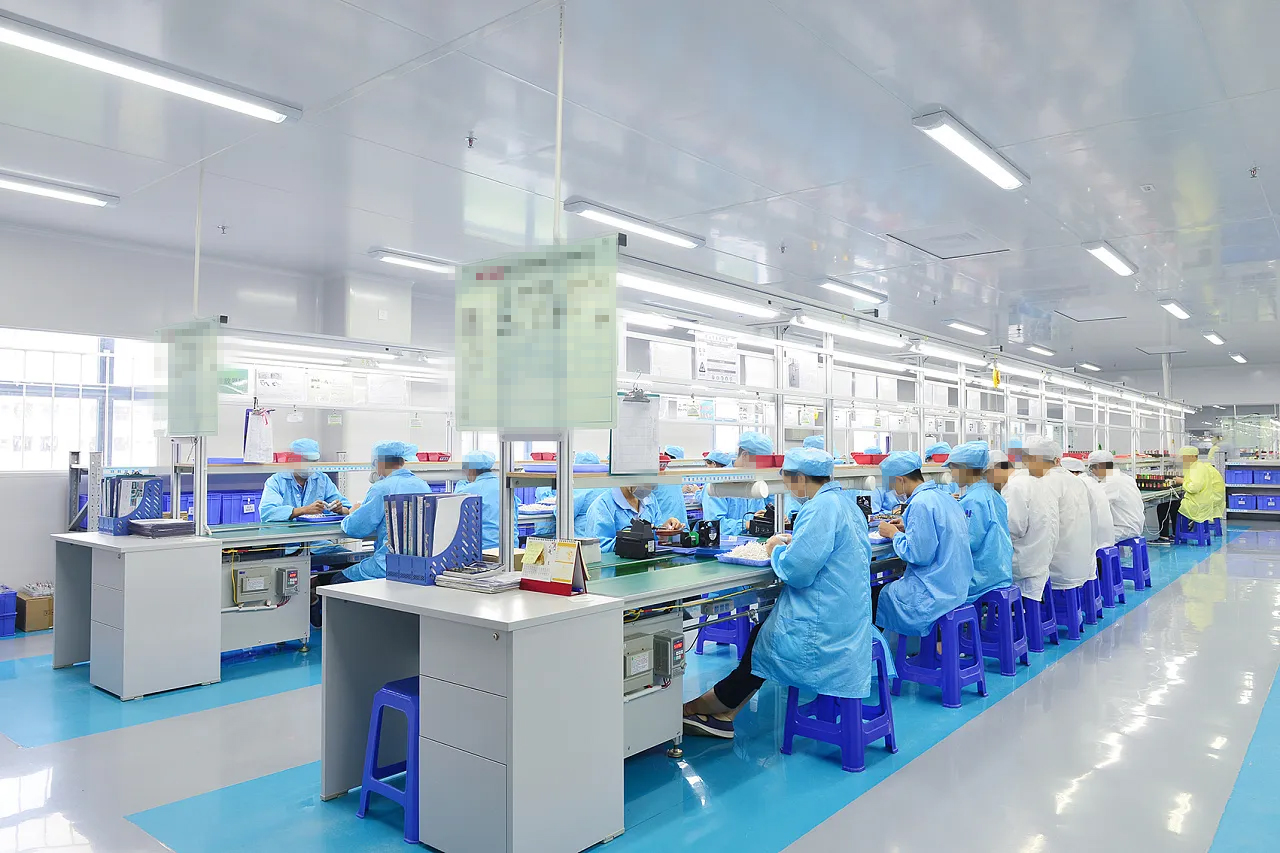
We have established a professional acoustic R&D and production team, optimized the sound unit tuning and noise reduction technology debugging processes, and introduced automated calibration equipment to ensure precise control of acoustic performance; adopted high-precision welding technology and high-quality wireless modules, combined with repeated testing and optimization, to achieve a balance between low latency and battery life; relied on an ergonomic database to optimize product structure design, strictly select materials, and balance comfort and durability; established a full-process quality control system to standardize component procurement, production and assembly, and finished product testing, ensuring quality consistency.
The production and manufacturing of professional gaming headphones is a comprehensive competition of technology, craftsmanship, and details.
Breaking through each difficulty requires long-term technical accumulation and practical polishing. In the future, our company will continue to deepen technological R&D and production process upgrading, rely on its own OEM/ODM service advantages, help cooperative brands break through manufacturing bottlenecks, create high-quality gaming headphones that meet professional e-sports needs, and promote the high-quality development of the professional e-sports peripheral industry.